
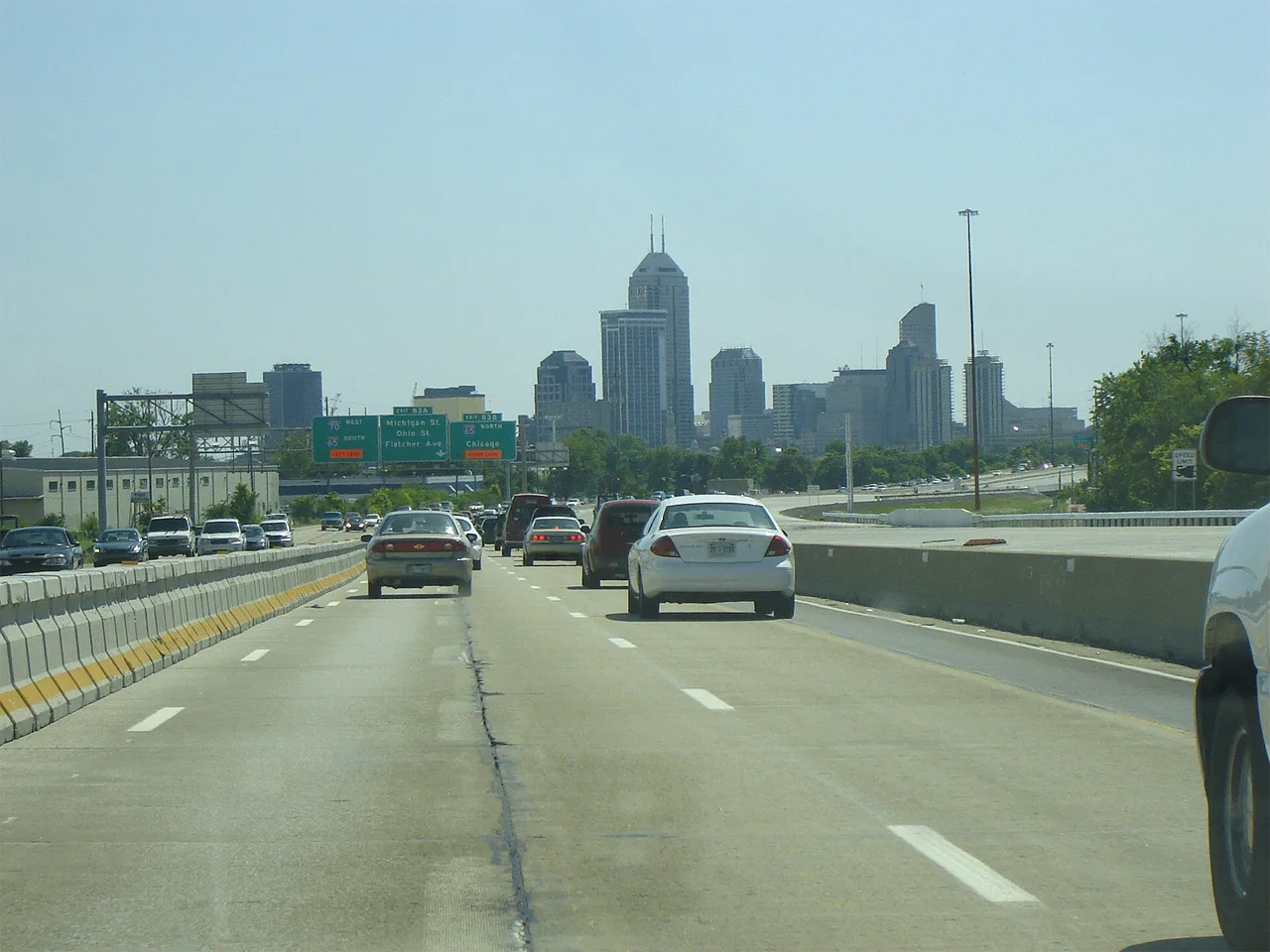
Indiana · In-building cellular
Commercial Cellular DAS & Signal Boosters — Indiana
We design and install multi-carrier cellular DAS, repeater and amplifier systems for commercial buildings across Indiana — from 5,000 sq ft offices to distribution buildings and plants over a million square feet.
FCC-approved products Manufacturer-certified technicians AT&T, Verizon & T-Mobile
Request a quote
Tell us about the building. We’ll come back with what it would take to fix the coverage.
"*" indicates required fields
Seamless Cellular is a manufacturer-certified cellular DAS integrator serving Indiana, working from our headquarters in Midland, Michigan. We design and install multi-carrier systems supporting AT&T, Verizon and T-Mobile in buildings from 5,000 to over 1,000,000 square feet — the manufacturing, warehousing and distribution buildings that make up most of Indiana’s commercial stock. All products are FCC-approved and all installation technicians are manufacturer-certified.
The Indiana problem
Why do buildings in Indiana lose cellular signal?
Indiana is not short of outdoor coverage. Verizon reaches 99.64% of Indiana households on 4G LTE and AT&T 99.51%, and by land area both are above 96% — among the best figures in the Midwest.
Indiana’s problem is that it is the most industrial state in the country, and industrial buildings are the hardest buildings to cover.
Manufacturing accounts for 24.0% of Indiana’s GDP, the highest share of any state in the nation. Northwest Indiana’s Calumet region is the largest steel-producing area in the United States at roughly 27% of national output; Indiana is the second-largest automotive manufacturing state; more than 80% of America’s recreational vehicles are built in and around Elkhart; and Indianapolis runs the second-largest FedEx Express hub in the world, with Indianapolis International handling 899,065 metric tons of air cargo in 2025. All of that happens inside steel-framed, metal-clad, concrete and masonry buildings on very long spans — and those are precisely the materials and dimensions that stop a cellular signal before it reaches anyone working inside.
Signal loss through common building materials
Low-E glass alone blocks roughly 99.9% of the signal reaching it. Put several of these materials in series, as every multi-storey plant and hospital does, and a strong outdoor signal becomes no usable service two rooms in.
Distribution and warehouse buildings
Indiana’s logistics corridors are full of million-square-foot buildings with metal cladding, clear-height racking and steel roof deck. Racking alone reflects and blocks signal aisle by aisle, so coverage that tests fine in an empty bay fails once the building is loaded.
Heavy steel and process plants
The Calumet mills and the state’s foundries and process plants are the most hostile RF environments in commercial construction — massive steel structure, continuous metal enclosure, overhead crane runs and electrical noise, all in the same building.
Limestone and older institutional buildings
Indiana limestone built much of the state’s campus and civic architecture, and it is dense, thick and usually backed by concrete. These buildings have deep interiors and small window openings, which is the combination that leaves people unreachable two rooms in.
- Indiana cities served
- Indianapolis, Fort Wayne, Evansville, South Bend, Carmel, Fishers, Bloomington, Hammond & statewide
- Carriers supported
- AT&T, Verizon and T-Mobile — multi-carrier systems
- Building sizes
- 5,000 to over 1,000,000 sq ft
- Common verticals
- Manufacturing, warehousing and distribution, healthcare, higher education
- Credentials
- FCC-approved products; manufacturer-certified installation technicians
- Coverage
- Manufacturer-certified installers serving Indiana
- Also available
- C-band 5G systems, upgrades to discontinued amplifiers, and remote monitoring for single and multi-site estates
Statewide
Cities we serve in Indiana
Indiana’s coverage problems follow the building stock, and it changes markedly between the logistics ring around Indianapolis, the steel corridor on Lake Michigan and the campus towns. Here is what we run into across the state’s major markets.
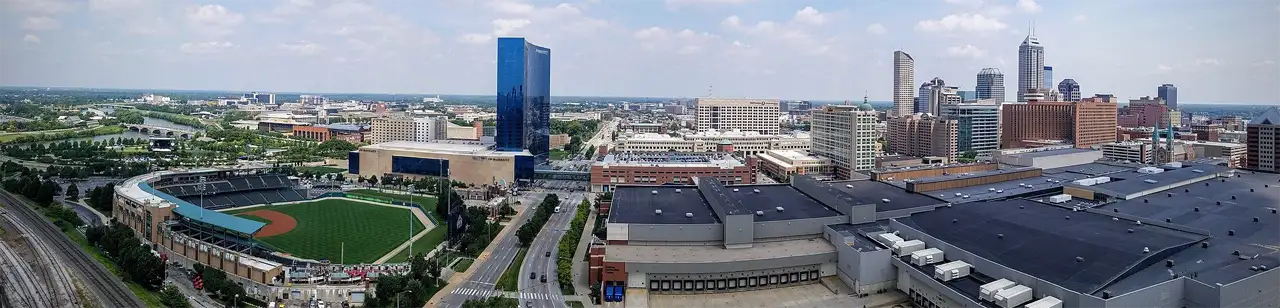
Indianapolis
The logistics ring — air-cargo, parcel and third-party warehouse buildings around the airport — plus downtown concrete towers and pharmaceutical research and production space. Three different RF problems in one metro.
Fort Wayne
Defence electronics, medical device manufacturing and older masonry industrial, alongside two large hospital campuses. Precision manufacturing space is often shielded on purpose, which makes it very good at excluding cellular signal too.
Evansville
Ohio River industrial and plastics manufacturing with river-barge logistics, plus a nearby automotive assembly plant. Large single-storey metal buildings on wide sites.
South Bend
A university campus of heavy masonry and stone next to the brick-and-timber remains of the Studebaker-era industrial district, much of it now converted to offices and labs with the original structure intact.
Carmel
Newer Class A office and corporate campuses, most of it reflective and low-E curtain wall. It performs well thermally and badly for radio — that glazing costs 30 to 34 dB on its own.
Fishers
Life-sciences and technology corporate campuses on newer tilt-up concrete. Tilt-up is a uniform, continuous concrete envelope, so signal enters almost entirely through the glazing or not at all.
Bloomington
A limestone university campus and medical device manufacturing. Indiana limestone is dense, thick and usually backed by structural concrete, and the older campus buildings have deep interiors with small openings.
Hammond
The Calumet corridor — steel, chemicals and heavy process plants in continuous metal enclosure, with overhead crane runs and electrical noise on top of the structural problem.
Gary
Integrated steel making on an enormous footprint. These are the hardest buildings for cellular coverage in commercial construction, and no system here can be designed from a floor plan alone.
Lafayette
A major university campus alongside automotive assembly — a stone-and-concrete institutional estate and a long metal-clad production building in the same market, needing completely different designs.
We install statewide, not only in the metros — a great deal of Indiana’s manufacturing sits in smaller towns along the I-65 and I-70 corridors, in Elkhart County’s RV plants and across the agricultural counties. If your building is in Indiana, we can survey it.
Verticals
Industries we serve in Indiana
Manufacturing & distribution
Manufacturing is 24.0% of Indiana’s GDP, a larger share than in any other state, and the buildings run from Calumet steel mills to Elkhart RV plants to million-square-foot distribution centres on the interstate corridors. They share one property: steel and metal enclosure over spans long enough that a single donor point cannot reach the far wall.
Manufacturing & distribution DASHealthcare
Indiana’s hospital systems run large multi-building campuses in Indianapolis, Fort Wayne, Evansville and South Bend. Dense concrete, lead-lined imaging suites and long interior corridors put clinical staff furthest from an exterior wall at exactly the moment a dropped call matters most.
Healthcare DASHigher education
Indiana’s universities operate large estates of limestone, stone and mid-century concrete buildings with high user density and almost no tolerance for dead space. We have completed campus installations elsewhere in the country, including Illinois Valley Community College and The Ohio State University.
Education DASProof
Our work in Indiana
We do not publish named Indiana projects. Seamless Cellular has installed nationwide since 2017, including FedEx systems across major distribution hubs nationwide — directly relevant to a state that runs the second-largest FedEx Express hub in the world — alongside work for Bank of America, Hilton, Marriott, Starbucks and federal agencies, and manufacturing installations in neighbouring Ohio, Michigan and Illinois. All products are FCC-approved and every installation technician is manufacturer-certified. Ask at survey and we will tell you honestly what comparable work we can point to.
Process
How a DAS installation works in Indiana
Site survey
We measure actual signal strength by carrier throughout your building and identify usable donor signal. In a loaded warehouse or a mill we survey the building as it operates, not as it looks on a drawing — racking and machinery change the answer.
System design
We size the system to your square footage, construction and carrier requirements — a repeater system under 20,000 sq ft, a full DAS above it.
Carrier coordination
Multi-carrier systems require carrier approval. We handle it.
Installation
Manufacturer-certified technicians, working to your site’s safety requirements.
Verify & support
We test coverage throughout the building before we leave, and support the system afterwards.
Also available
5G, system upgrades and remote monitoring in Indiana
Will your system carry 5G in an Indiana plant or warehouse?
Amplifiers work on frequency, not on the name of the technology. Carriers run low-band 5G on the same 600, 700, 850 and 1900 MHz frequencies as LTE, so a properly designed multi-band system passes the 5G phones spend most of their time on. Indiana shows the carrier split unusually clearly: T-Mobile is effectively 5G-first here, reaching 95.60% of households and 87.79% of the land area with 5G while covering only 71.66% of the land on 4G LTE — where AT&T and Verizon are both above 96% on LTE land coverage but behind on 5G. Which carrier your workforce is on changes which bands actually matter in your building.
The exception is where the capacity lives. C-band runs at 3.7–3.98 GHz and sits outside the frequencies standard FCC-certified boosters are authorised to carry, as does 2.5 GHz. Verizon holds 140–200 MHz of C-band in every available market, AT&T about 120 MHz, T-Mobile about 40 MHz.
In Indiana that gap bites hardest in distribution. A parcel, retail or third-party warehouse building runs on handheld scanners, vehicle-mounted terminals, label printers and increasingly sensors on the material-handling equipment itself — dozens or hundreds of devices competing for indoor capacity across a floorplate where steel racking blocks and reflects signal in every aisle. A system sized for voice when the building opened will not carry that, and the complaint arrives as slow scan rates rather than dropped calls.
The fix is a purpose-built C-band system, FCC-certified for the purpose, running alongside an existing multi-band install rather than replacing it. If indoor throughput rather than call quality is what brought you here, say so at survey — it changes the design.
Upgrading amplifiers Indiana buildings have outgrown
Indiana fitted out an extraordinary number of warehouse and distribution buildings along I-65 and I-70 during the 2010s, each to a specification written for the traffic of the time. Those systems can be underperforming now with nothing actually broken, because the networks moved and the device count multiplied. Three things age equipment out:
- The 3G shutdowns. AT&T switched off 3G on 22 February 2022; Verizon and T-Mobile followed on 31 December 2022. Equipment specified around those networks lost what it was tuned for.
- Missing bands. Older five-band units never covered 600 MHz Band 71, now core T-Mobile low-band territory, and many never covered Band 14 for FirstNet.
- Pre-2014 certification. FCC Part 20 requires oscillation detection, automatic gain control and power-down near a cell site. Older units predate that standard, and operating a booster without valid FCC certification is not lawful.
Those buildings are now running far more devices on equipment that lost its 3G bands in 2022 and never had Band 71 at all. The problem reaches beyond the interstates too — Elkhart County’s RV plants and the older Calumet industrial estate, where amplifiers installed during one expansion are quietly limiting the next.
We survey what is installed and tell you what is salvageable — frequently the coaxial runs, antenna positions and mounting, which is most of the installation cost. Replacing only the head-end and the bands you are missing is typically a fraction of a new system, and across a distribution network it can be staged building by building.
Monitoring coverage across multiple Indiana sites
Most coverage failures are found by a complaint, weeks after they start. Monitored systems report status continuously, so a fault becomes a notification rather than a discovery.
In Indiana the single-building view is rarely the right one. An operator here typically has a national or regional distribution network with several Indiana buildings in it, because the state’s position on the interstate system is the reason the buildings are here at all. When coverage drops in one aisle of one building, the shift works around it; nobody raises a ticket, and the productivity loss shows up in scan rates rather than in a help-desk queue. A retail estate, a hospital system with outlying clinics or a manufacturer with four plants and a warehouse has the same blind spot.
We have installed across national footprints before — FedEx systems in major distribution hubs nationwide — and at that scale the operational problem is never one building. It is knowing which of forty buildings is degraded this week. On supported hardware we can see system status remotely and, in many cases, diagnose, reset a unit or adjust bands without a truck roll to Evansville or Gary.
Monitoring needs a connection at install — Ethernet or a cellular modem — so it is far cheaper to specify up front than to retrofit across an estate.
Questions
Indiana DAS & signal booster FAQ
Because the signal is being stopped by the building, not missing from the area. Verizon covers 99.64% of Indiana households on 4G LTE and AT&T 99.51%, so the outdoor signal is almost always there. Brick costs 7 to 12 dB, six inches of concrete 10 to 19 dB, metal cladding considerably more, and low-E glass 30 to 34 dB. Indiana’s industrial and distribution buildings combine steel structure, metal enclosure and very long spans, which is why coverage can be full in the yard and unusable at the back of the building.
Square footage is the usual dividing line. Under about 20,000 sq ft, a commercial cellular repeater or amplifier system is normally sufficient and considerably cheaper. Above that, or where you need guaranteed capacity for a large number of simultaneous users or devices, a distributed antenna system is the right answer. Most Indiana distribution and manufacturing buildings are well past that line on floor area alone, and racking and machinery push them further — a site survey settles it.
Yes. We design multi-carrier systems that support all three, and Indiana is a good illustration of why that matters. AT&T and Verizon both cover more than 96% of the state’s land area on 4G LTE while T-Mobile covers 71.66%, but T-Mobile leads on 5G with 87.79% of the land area against AT&T’s 60.09% and Verizon’s 25.07%. A single-carrier system leaves part of your workforce without usable service, and which part depends on the carrier and the technology.
Yes, and buildings of that size are a large part of what we do. The design problem is not the floor area by itself but the racking: steel shelving reflects and blocks signal aisle by aisle, so a system that tests clean in an empty building can fail once it is loaded. We survey the building as it operates, design antenna placement around the rack layout and the material-handling equipment, and size the system for the number of devices actually on it — scanners, vehicle terminals and printers, not just phones. Where a building is part of a larger network, we would also recommend remote monitoring at install.
Yes for the low-band 5G phones use most of the time, because carriers run it on the same 600, 700, 850 and 1900 MHz frequencies as LTE and a multi-band system passes those. Indiana’s carrier split makes multi-carrier design matter: T-Mobile reaches 87.79% of the state’s land area with 5G against Verizon’s 25.07%, while Verizon and AT&T lead on LTE. Dedicated mid-band is different — C-band at 3.7–3.98 GHz and 2.5 GHz sit outside what standard FCC-certified boosters are authorised to carry, and that is the spectrum carrying real throughput for a building full of scanners.
Usually, and it is often the cheapest fix available. The commonest causes are age rather than failure: 3G networks were switched off in 2022, so equipment specified for them lost the networks it was tuned to; older five-band units never covered 600 MHz Band 71, which is now core T-Mobile territory; and boosters made before the FCC’s 2014 rules lack the oscillation detection and automatic gain control that current certification requires. This is common in Indiana warehouses fitted out in the 2010s and now running many times the device count they were sized for. We survey the existing install, tell you what is salvageable — often the coaxial runs and antenna positions — and quote on replacing only the parts that need it.
Get a free cellular distributed antenna system installation quote for your Indiana building
Tell us the address, the square footage and what your coverage is like now. We’ll tell you what it would take to fix it.