
Cellular Repeater vs. DAS: Which Do You Need?

A cellular repeater amplifies one signal for a small space. A DAS spreads coverage through a large building. Compare how each works and which one fits.
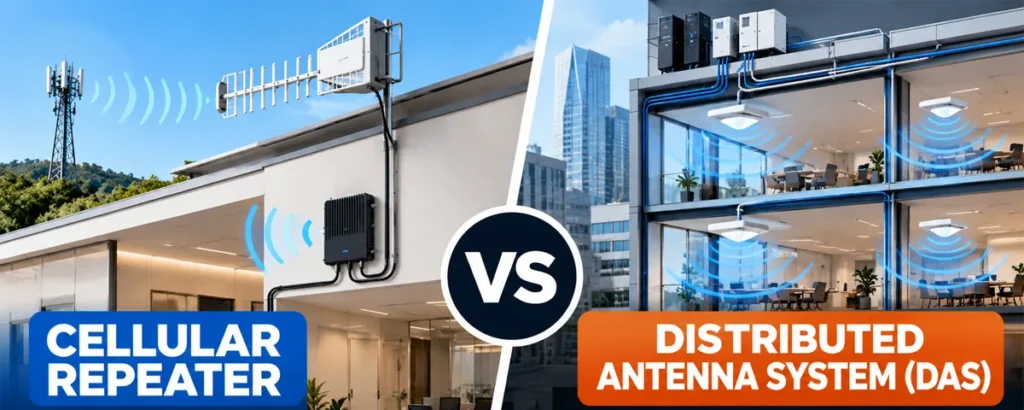
A cellular repeater and a distributed antenna system (DAS) both fix weak indoor coverage, but they work at different scales. A repeater captures an existing signal with one outside antenna, amplifies it, and rebroadcasts it inside. A DAS carries the signal to many antennas placed throughout a building. Repeaters suit homes and small spaces. A DAS suits large, multi-floor or complex buildings. The FCC calls repeaters signal boosters, and this post uses the terms interchangeably for a single-antenna system.
The line between them is not absolute. A DAS fed by an off-air donor antenna is, in effect, a booster with a distribution network. What separates the two is the number of areas that need coverage and where the signal source comes from.
Key Takeaways
- A repeater has one outside antenna, an amplifier and an inside antenna. A DAS has a signal source, a distribution network and many antennas.
- Choose a repeater for one home, a small office or a single area. Choose a DAS when coverage has to reach many floors or zones.
- A passive DAS carries the signal over coaxial cable with no electronics between the antennas and the source. An active DAS uses powered remote units fed over fiber.
- In the U.S., 47 CFR 20.21 requires carrier consent for boosters. Large installations are normally designed by a qualified integrator and arranged with the carriers and local authorities.
Cellular Repeater vs. DAS at a Glance
| Cellular repeater | Distributed antenna system (DAS) | |
|---|---|---|
| How it works | One outside antenna captures the signal, an amplifier boosts it, an inside antenna rebroadcasts it | A signal source feeds a distribution network that serves many antennas |
| Typical building | Home, small office, vehicle | Large commercial buildings, campuses, venues, multi-floor buildings |
| Coverage | One area around the inside antenna | Many areas, each served by its own antenna |
| Signal source | Off-air signal from a cell tower | Off-air donor antenna, small cell or carrier base station |
| Carrier approval (U.S.) | Consumer booster: carrier consent and registration | Off-air systems need licensee consent. Carrier-fed systems are arranged with the carrier |
| Design effort | Often a product you can install yourself | Engineered design, installation and commissioning |
How a Cellular Repeater Works
A repeater has three components:
- External antenna. It captures the signal from the nearest cell tower.
- Signal amplifier. It increases the power of the captured signal.
- Internal antenna. It rebroadcasts the amplified signal inside.
A repeater can only amplify a signal that already reaches its outside antenna. That makes it a good fit for homes, small offices and vehicles with usable signal outside and poor signal inside. Our cell phone repeater guide covers types, selection and installation.
In the U.S., a consumer booster is covered by 47 CFR 20.21. The subscriber must obtain the consent of their carrier and register the booster with the carrier before operating it. They must also use the antennas and cables the manufacturer specifies.
How a Distributed Antenna System Works
A DAS provides wireless coverage across a large building or area. A signal source feeds a distribution network, which serves multiple antennas placed throughout the space. The source can be an off-air donor antenna, a small cell or a connection to a carrier base station.
DAS comes in two main types:
- Passive DAS. A coaxial cable carries the signal, with no electronic components between the antennas and the source. RCR Wireless explained in 2016 that antennas get weaker the farther they are from the base station, because nothing amplifies the signal along the way.
- Active DAS. Powered, managed remote units receive the signal over fiber optic cable. The same article notes that this suits large areas, since the units can sit far from the base station.
A DAS can be designed for several carriers and frequency bands, and it can be extended as the building or the technology changes. Our DAS installation page describes how these projects are designed and installed.
Why Building Construction Matters
Indoor coverage depends on the building as well as the signal outside. In a 2014 IEEE study of outdoor-to-indoor attenuation from 800 MHz to 18 GHz, Rodriguez Larrad and colleagues at Aalborg University found that modern constructions lost 20 to 25 dB more on average than an old building, which stayed below 10 dB. They attribute the loss to energy-efficient materials such as thick reinforced walls and multi-layer, metal-coated windows.
When construction blocks signal in many places, one inside antenna cannot cover every area, which is where a DAS earns its place. Our post on low-E glass and cell signal explains one common cause.
How to Choose Between a Repeater and a DAS
Choose a repeater when:
- The space is a single home, small office, vehicle or one area of a building.
- A usable signal reaches the spot where you can mount an outside antenna.
- You need coverage for a limited number of rooms or users.
Choose a DAS when:
- Coverage has to reach many floors, wings or zones.
- The building is large, or its construction blocks signal in many places.
- Several carriers must be supported.
- The building is a venue, campus or public venue with many users at once.
- Emergency responder radio coverage is required. Many jurisdictions adopt International Fire Code Section 510 and NFPA 1221 for certain buildings, and thresholds vary, so confirm the requirements with your local fire authority. See our public safety DAS page.
If you are unsure, a site survey settles it. It measures the signal outside, maps the dead zones inside, and shows whether one repeater can cover the area or the building needs a distributed design. For smaller sites, see our small commercial solutions.
Carrier Approval and FCC Rules
The FCC rule in 47 CFR 20.21 draws a line between consumer and industrial boosters. A consumer booster is operated by a subscriber with their carrier’s consent. An industrial booster is operated by someone who holds an FCC license or has the express consent of the licensee whose frequencies are retransmitted.
Off-air systems, whether a large repeater or a DAS fed by a donor antenna, retransmit a carrier’s signal and need that consent. A DAS fed directly by a carrier is arranged with that carrier. Boosters operate on a secondary, non-interference basis, and an operator must cooperate in finding the source of interference and deactivate the booster if required.
Cellular Repeater vs. DAS FAQs
What is the difference between a cellular repeater and a distributed antenna system?
A cellular repeater amplifies and rebroadcasts the signal from a single inside antenna to improve coverage in one area. A distributed antenna system (DAS) uses multiple antennas placed throughout a building or area to provide coverage and capacity across all of it.
Can a repeater cover a whole building?
Only a small one. A repeater covers the area around its inside antenna, and walls and floors reduce that coverage. Large or multi-floor buildings are usually better served by a DAS.
What is the difference between a passive and an active DAS?
A passive DAS carries the signal over coaxial cable with no electronics between the antennas and the source, so signal weakens with distance. An active DAS uses powered remote units fed over fiber, which suits large areas.
Do I need carrier approval for a repeater or a DAS?
In the U.S., yes for off-air systems. 47 CFR 20.21 requires carrier consent and registration for consumer boosters, and an FCC license or licensee consent for industrial boosters. A DAS fed directly by a carrier is arranged with that carrier.
Does a DAS support more than one carrier?
It can be designed to. A DAS can support several carriers and frequency bands, which is one reason it suits large commercial buildings. Each carrier’s participation must be arranged. See our repeater FAQ for more questions.
Questions About Your Application?
Tell us about the building, the carriers you need and where coverage drops, and a system specialist will recommend a design. Contact a system specialist.
- Federal Communications Commission, 47 CFR § 20.21, Signal boosters. ecfr.gov.
- Phillip Tracy, “What is a DAS? Active vs. passive, role of CPRI and more,” RCR Wireless News, July 6, 2016. rcrwireless.com.
- Rodriguez Larrad, Nguyen, Jørgensen, Sørensen and Mogensen, “Radio Propagation into Modern Buildings: Attenuation Measurements in the Range from 800 MHz to 18 GHz,” 2014 IEEE 80th Vehicular Technology Conference (VTC2014-Fall). DOI 10.1109/VTCFall.2014.6966147; abstract at Aalborg University.
