
Low-E Glass Can Weaken Cell Signal: DAS Fix

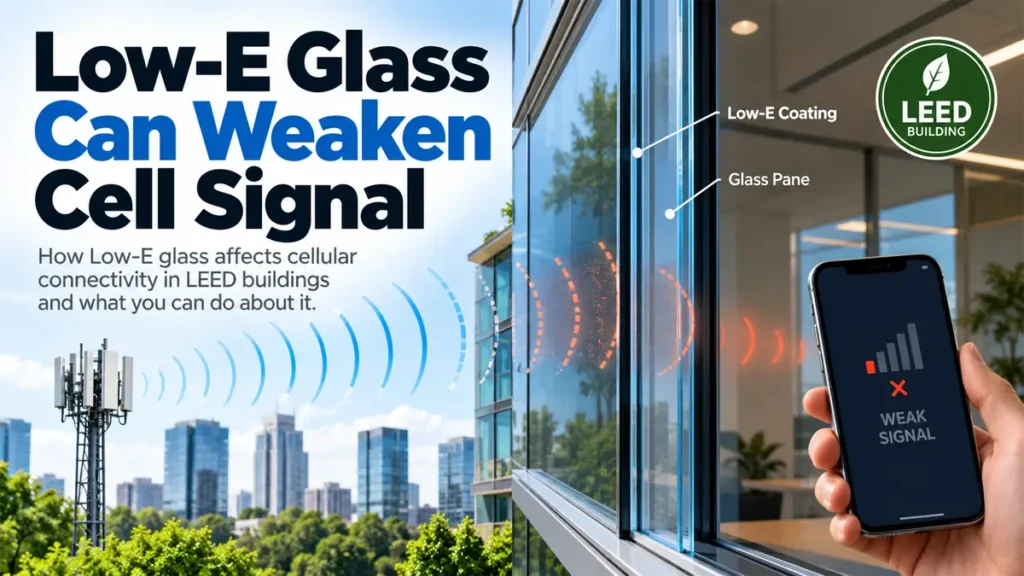
Low-E glass can weaken cell signal indoors. Learn why LEED buildings lose coverage and how a distributed antenna system (DAS) restores it.
Key Takeaways
– Low-E coatings contain thin conductive metal layers. They reflect infrared heat and can also block cellular signals.
– One patent’s background cites losses of 30 dB or more through low-E windows. A 2014 IEEE study measured an average 20 to 25 dB increase in modern buildings compared with an older one.
– A DAS places antennas throughout the building, so coverage does not depend on signal passing through the glass. – Start with a site survey. It shows where coverage fails and which carriers and bands the design must support.
How Low-E Glass Affects Cellular Signals
Low-E glass carries a thin, transparent coating that reflects heat while letting visible light through. The coating reduces heat transfer between inside and outside, which lowers heating and cooling demand. LEED rewards energy performance, and low-E glazing is a common way to earn those points. LEED does not require any one glass type.
The same coating is the problem for cell service. A patent on RF-friendly low-E glass, US 10,654,131, describes these coatings as “comprised mainly of metals,” which makes them conductive and reflective to radio signals. It states that signals through such windows “can be attenuated at levels of 30 decibels (dB) or more.” That figure is the patent’s background claim, not an independent test, and it varies with the coating, the glass and the frequency.
Independent measurements point the same way. In a 2014 IEEE study, Rodriguez Larrad and colleagues at Aalborg University measured outdoor-to-indoor attenuation from 800 MHz to 18 GHz. They found an average increase of 20 to 25 dB in modern constructions compared with the old building, which stayed below 10 dB. They link the loss to energy-efficient materials such as thick reinforced walls and multi-layer, metal-coated windows, and report that attenuation depends on both material and frequency.
Decibels (dB) are a logarithmic loss scale: every 3 dB of loss roughly halves the signal power, so a loss of 20 dB or more leaves very little signal for a phone to use. Occupants see dropped calls, slow data and unreliable service indoors, even when the signal outside is strong.
Your Options for Fixing Coverage
| Option | How it works | Fits |
|---|---|---|
| Distributed antenna system (DAS) | Antennas inside the building carry the signal to every area, bypassing the glass | Large or multi-floor buildings, several carriers |
| Signal repeater (booster) | An outside antenna captures signal, an amplifier boosts it, an inside antenna rebroadcasts it | Smaller spaces. See the cell phone repeater guide |
| RF-transparent glass | The coating is patterned, for example with laser-ablated lines, so signal passes through | New glazing or replacement, decided at the design stage |
The patent above reports that one ablation pattern cut insertion loss from over 35 dB to under 10 dB. That is the patent owner’s own result, and it applies only to glazing built or treated that way. Most existing buildings already have coated glass, which is why a DAS or repeater is the usual fix. Our repeater vs. DAS comparison explains how to choose between them.
How a Distributed Antenna System Works
A DAS is a network of antennas placed throughout a building to improve signal strength and reliability. It has four main parts:
- Signal source. A connection to a carrier base station, a small cell, or an off-air signal captured by a donor antenna.
- Headend equipment. It processes and amplifies the signal before distributing it.
- Remote antennas. They are installed through the building to transmit and receive signals, so coverage reaches every area.
- Cabling. It connects the headend equipment to the remote antennas.
Because the antennas sit inside the building, coverage does not depend on signal getting through the glass. That is why a DAS is the common answer for buildings with coated glazing.
What a DAS Gives Building Owners
- Reliable coverage. A well-designed system covers the whole building and offsets the loss through the glass.
- Better data speeds. A stronger signal supports faster, more consistent data.
- Tenant satisfaction. Dependable service matters to occupants and can support tenant retention.
- Room to grow. A DAS can be designed for several carriers and for later upgrades.
Public Safety DAS and Emergency Responder Coverage
Coverage matters most in an emergency. Many jurisdictions adopt International Fire Code Section 510, which requires approved radio coverage for emergency responders inside certain buildings, designed to NFPA 1221. Triggers, thresholds and code editions vary by jurisdiction, so confirm the requirements with your local fire authority. Low-E and other energy-efficient glass can reduce the public safety signal as well as the commercial one. See our public safety DAS page for how an emergency responder system fits with a commercial DAS.
Planning and Installing a DAS in a Building With Low-E Glass
Site Survey and Design
A DAS project starts with a site survey. The survey measures signal strength, finds dead zones and identifies the areas that need improvement. The design is then built around those measurements and the building’s layout.
Selecting the Right Components
- Carrier compatibility. Confirm the system supports the frequency bands of every carrier that serves the building. For an off-air system, 47 CFR 20.21 requires the express consent of each licensee whose frequencies the industrial booster retransmits.
- Coverage area. Choose antenna types and power levels that match the layout of each floor.
- Scalability. Pick a system that can add carriers and frequencies later.
Installation and Commissioning
A qualified DAS integrator should oversee installation. That includes mounting the remote antennas, routing and connecting the cabling, and configuring the system for performance and signal quality. After commissioning, ongoing maintenance and monitoring keep the system working. See our DAS installation services.
Low-E Glass and Cell Signal FAQs
Does low-E glass block cell phone signal?
It can. Low-E coatings contain thin conductive metal layers, which reflect radio signals as well as heat. The loss varies with the coating, the number of glass layers and the frequency. One patent’s background cites losses of 30 dB or more.
Does LEED require low-E glass?
No. LEED rewards energy performance, and low-E glazing is one common way to achieve it. A LEED building without low-E glass can still have coverage problems from other energy-efficient construction, such as thick reinforced walls.
Can a cell phone repeater fix the problem?
For a small space, often yes. A repeater captures signal outside and rebroadcasts it inside. For large or multi-floor buildings, or several carriers, a DAS is the better fit. See the repeater guide.
Do I need carrier permission to install a DAS?
In the U.S., an off-air booster or a DAS fed by a donor antenna retransmits a carrier’s frequencies, so it needs an FCC license or the licensee’s express consent under 47 CFR 20.21. A project covering several carriers needs each carrier’s consent. A DAS fed directly by a carrier is arranged with that carrier.
Can the glass itself be changed instead?
Yes, for new or replacement glazing. Coatings can be patterned so radio signals pass through, as the patent above describes. It does not help the many buildings whose coated glass is already installed.
Questions About Your Application?
Tell us about the building, the glass, the carriers you need and any emergency responder requirement, and a system specialist will recommend a design. Contact a system specialist.
- Estinto and Winsor (Clearbeam Inc), “Low-emissivity coated glass for improving radio frequency signal transmission,” US Patent 10,654,131 B2, granted 2020-05-19. Google Patents. Background statements are the inventors’ claims.
- Rodriguez Larrad, Nguyen, Jørgensen, Sørensen and Mogensen, “Radio Propagation into Modern Buildings: Attenuation Measurements in the Range from 800 MHz to 18 GHz,” 2014 IEEE 80th Vehicular Technology Conference (VTC2014-Fall). DOI 10.1109/VTCFall.2014.6966147; abstract at Aalborg University.
- Federal Communications Commission, 47 CFR § 20.21, Signal boosters. ecfr.gov.
